
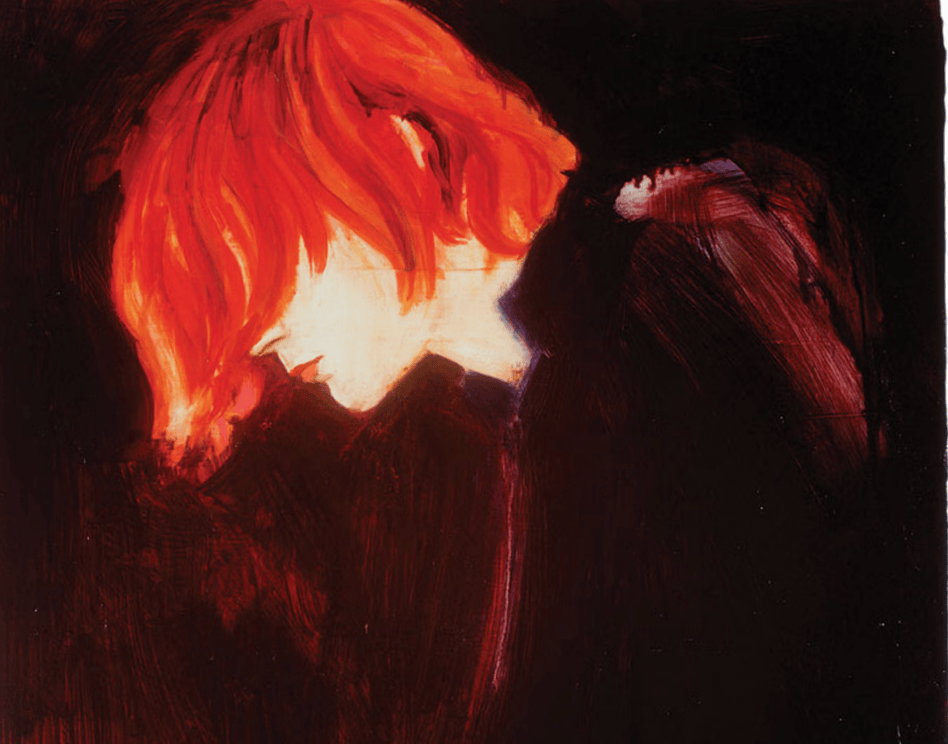
Painting: Alizarin Kurt’ by Elizabeth Peyton, 1995
You’re eleven years old and you’ve just had a fight with one or both of your parents. Maybe your brother was thrown in for good measure; he’s much older, allied with the grown-ups. You slam first the kitchen door, then stomp up the wooden stairs, feeling the banister tremble as you ascend; give an extra stomp on the final step, and then, the pièce de résistance, you slam your bedroom door.
It’s time for music. At full volume. With speakers.
Despite all my rage, I am still just a rat in a cage*
The consequences will come, and quickly, but for those brief fifteen or twenty seconds that you play the music at full blast, you are in charge of your kingdom.
*for the pedantic among you (i.e. me), yes The Smashing Pumpkins are grunge-adjacent, not classic grunge.
~
Born in 1984, I was still a kid when grunge reached its zenith, and no, I did not see Nirvana or Sonic Youth play Sir Henry’s in Cork, as the majority of its inhabitants claim to have. For a while, grunge held my attention and was a vessel for my eleven-year-old rage. I tore holes in my baggy jeans, replaced the white laces in my All Star Converse with black ones, wrote the names of bands in Tipp-Ex on my army surplus school bag. I lit a tealight for River Phoenix every Halloween, the anniversary of his death, and stole black Carroll’s kohl eyeliner from the pound shop.
Grunge understood that the world could be unbearable. It gave misery a sonic platform, made alienation something you could wear, gave you permission to be furious without having to explain yourself. But it was also, in its way, a closed circuit. The pain plugged in, the noise came out, and the world remained much as you’d found it. I was beginning to suspect that my unhappiness had something to do with the world beyond my bedroom.
In 1995, Coolio’s ‘Gangsta’s Paradise’ was everywhere. Released just a few months before the Smashing Pumpkins’ Mellon Collie and the Infinite Sadness, it offered a different account of what it meant to be trapped:
Look at the situation they got me facing,
I can’t live a normal life, I was raised by the street,
Grunge looked in the mirror, while there was a 1990s hip hop that looked out the window, or sometimes from inside a jail cell. It had little time for existential dread because it was busy surviving something. The war on drugs, systemic poverty, police brutality: hip hop named the circumstances in which people lived, and the people and institutions that helped create them.
And what on earth had this to do with a scrawny, pimply eye-lined white kid from a village in Ireland? Hip hop gave my rage somewhere to go and breathe. It suggested that anger might have causes beyond the self, that the feeling of being trapped could be shared, and most importantly that there might be something you could do about it. Rage with rhythm, with a pulse. And you could dance to it. You could whirligig yourself through the rage with the hip-swivel the Catholic Church had so long forbidden. You could swear, be sexy, laugh. The body that had been a container for all that impotent fury and frustration could become an instrument.
~
I dug deeper, into boom bap, a subgenre of hiphop that prioritises lyricism, complex rhyme schemes and social commentary: Mos Def, Nas, Jurassic 5. Nas’ Illmatic was close to reportage, the street-level detail of Queensbridge rendered with a cool eye and the only wailing that of sirens. Mos Def became my master satirist, railing against institutions with sustained wordplay. I had outgrown a way of being angry and found my forever home in the beat: struck, measured, repeated. Of course, hip hop contained plenty of anguish, contradiction and self-destruction, just as grunge could sometimes be political and a force for change. I wasn’t discovering a universal truth about the two genres, just a way of being angry that clicked for me: what came to be known as conscious hip hop. I yearned to be awake and alive to the world, not just myself.
And then I found Lauryn Hill, first through her band The Fugees, then her peerless 1998 solo album, The Miseducation of Lauryn Hill. Throughout the 1990s, raging women were treated as a mess (there’s a long precedent for this!). Courtney Love was pilloried by the tabloids, and so was Sinéad O’Connor, amongst others. Kurt Cobain and Billy Corgan were geniuses; Courtney Love was unhinged. That was how we were instructed to swallow it. A man’s rage could be evidence of his artistic genius. A woman’s could be evidence that something was wrong with her. Get her on the Prozac pronto.
Lauryn Hill did not escape scrutiny, but she gave me a different model of what anger could look and sound like. It was very clear what she was furious at, and with whom. Listen to ‘Lost Ones’ or ‘Ex-Factor’. She could accuse, lament, dissect a relationship, turn a grievance over until its contradictions showed. Her anger was not a loss of control. It was something she could work with, something she could shape.
Then there’s ‘Forgive Them Father’:
They say all the right things to gain their position
Then use your kindness as their ammunition
The title comes from Luke’s Gospel, Christ’s words from the cross, a line every Irish Catholic child knows. Hill takes that language of forgiveness and puts it to work in a world of betrayal, hypocrisy and self-interest. Forgiveness here isn’t simply an instruction to ingest your anger, to be good, to let the wrong go unexamined. Hill gets to decide what the words mean, and what they demand of her. She can name the wrong and retain the authority to respond to it. Rage and grace occupy the same song without cancelling each other out. That was what the eleven-year-old behind the bedroom door was missing. Not anger: she had plenty of that. Not even power, exactly. She could slam a door, turn up the speakers, make the whole house listen. But her kingdom lasted twenty seconds, because a scream only holds for so long.
Hill showed me another possibility. The power wasn’t just in making noise. It was in making something of it. I don’t slam doors much anymore. I write or sing instead. Or try to. Both give me somewhere to put the anger, but more than that, it lets me stay with it long enough to find out what it’s about. Who has done what to whom. What has been concealed, misrepresented, made to seem inevitable. Whether the thing I’m furious about is the thing I should be furious about. How I have wronged others. Sometimes the answers are personal; sometimes they’re political. Often they’re both. Sometimes I’m simply angry. Sometimes the page is another slammed door. But I have spent much of my life learning that the feeling itself is only the beginning. You can make a rageful noise and be heard, briefly, or you can make something that holds its shape after the noise has stopped.


Leave a Reply