
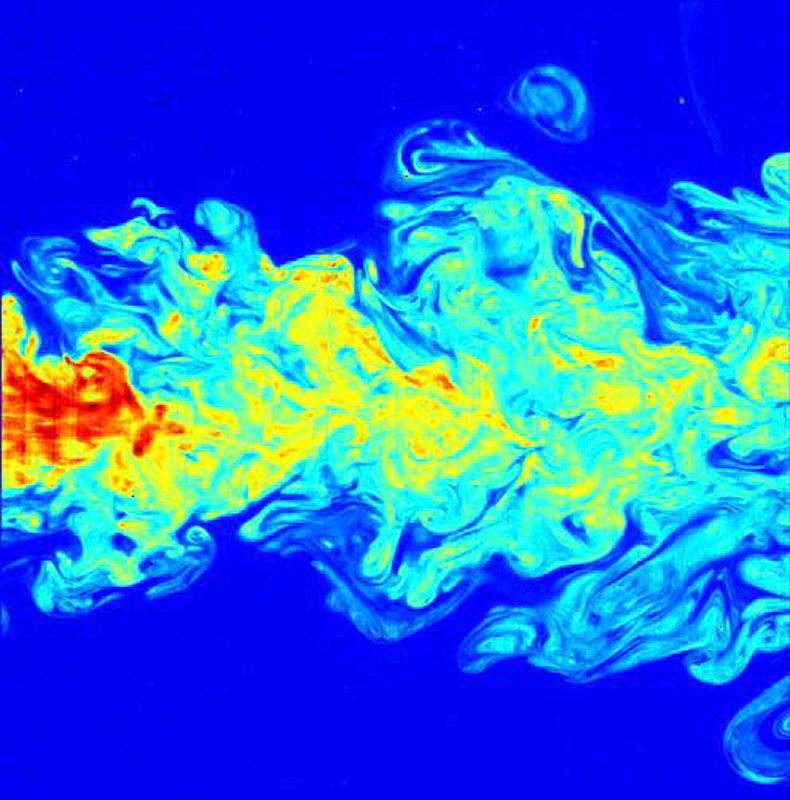
I heard a phrase on the airplane that I’d never encountered before: rough air. Before we took off, the pilot announced that he expected rough air over the Atlantic, and then, shortly before we arrived in Atlanta, where I was changing planes for New Orleans, he said it again. Rough air.
The word turbulence has been removed from many flight announcements, particularly on American airlines. It always struck me as a meaty, tangible word, doing many things at once, not least of all inciting anxiety 36,000 feet in the air. It comes from the Latin turba—a crowd, a commotion, a tumult—before becoming turbulentus: full of commotion. It is a word that tells you exactly what it means. Doesn’t the right word, after all, ask the right thing of us? So what disappears when turbulence becomes rough air?
Since landing two days ago in New Orleans, I have met, mostly on foot, people from Honduras, Israel, Trinidad and Tobago, Thailand and Guadeloupe. A lot of people frown when I speak here, more than I’m used to, and for the first time in a long while—probably not since I lived in the UK—I can hear just how pronounced my Irish accent is. It feels squiggly in the air as I speak, reckless somehow. Sometimes, when I hear locals talking quietly in their soft cadences, I can’t tell whether I’m hearing English or French until their voices resurface and I realise it’s English after all.
There is remarkable linguistic consensus around turbulence. French has la turbulence, Spanish la turbulencia, German die Turbulenz—all descendants of the same Latin root, turba, a crowd, a commotion. Arabic speaks of air disturbances; Mandarin of turbulent flow. Languages seem at ease with turbulence. Institutions, less so.
Each time the pilot said we were entering rough air, my brain silently translated it back into turbulence. I rail against rough air, not simply because a word as beautiful as air doesn’t need dressing up, but because it’s okay to be afraid. What bothers me is the assumption hidden inside the euphemism—that fear itself needs softening.
Oddly, I stayed in a hotel the night before moving into my apartment, and one of the signs in the corridor simply read ICE. For a split second I thought immigration services had taken up residence on one of the floors before realising it wasn’t an acronym at all, just that gentle lower-case ice, waiting to be dropped into drinks.
Rough air tells you much less than turbulence. It doesn’t reveal the intensity of the roughness, or ask anything of you except compliance. Paris has an old Latin maritime motto that resurfaced after the terrorist attacks of 2015: Fluctuat nec mergitur—tossed but not submerged. Threat, in all its forms and intensities, reshapes us. It changes our faces, the pitch of our voices, the way we carry ourselves through the world. So what happens when we begin to remove the words that acknowledge this? When language itself undergoes cosmetic surgery—reduction, erasure, a careful re-sculpting of reality? What happens when we exchange the honesty of turbulence for the benignness of rough air?
For me, turbulence, unadorned, tells you the cost of things. Your choice to leave. Your desire to arrive somewhere else. Your obligation to be elsewhere. It acknowledges that movement is rarely smooth, and that crossing from one place to another asks something of you; that it costs something. And surely that should, once in a while, scare the fuck out of you.
New Orleans, July 2026


Leave a Reply