A feeling can become foreign in a single day; what was once so much a part of us can suddenly live apart from us. Culturally and socially, we are told to follow our heart or use our head, as though these two choices are always separate.
They contain distinct moral positions. Your head is level: Apollo, master of your emotions. Your heart oscillates, indulges like Dionysus, lets feelings ramble. Your gut, on the other hand, never lies, apparently. Really, though?
As a writer, and perhaps you can relate, I try to follow perception more than expression. In Must You Live In The Real World?, we are going to prioritise perception because I believe it gives good fiction its strongest foundation.
Expression can be loosely defined as the communication of an inner state through language. Perception is the act of attending to and registering experience before it is interpreted, explained, or judged.
Attention comes from the Latin attendere, meaning “to stretch toward.” In French, attendre means “to wait.” The words share a root, as if attention contains within it a kind of waiting: a held openness toward what might appear, before we decide what it is.
Attention is not passive. It is a directed suspension; an active readiness that precedes meaning. In the upcoming programme, you won’t be asked to choose one over the other; we’re going to use the space as a training camp to strengthen our perceptual muscles.
Social media platforms present reality largely through the framework of feelings. But feelings leak, spread, evolve. Rainer Maria Rilke said, “No feeling is final,” and I reckon that’s a compelling case for giving perception at least as much attention as expression.
To help us do that, I’ve chosen a number of writers to study including Etgar Keret, renowned for his succinct, surreal and deeply human stories. Here is the opening of “One Gram Short,” published in The New Yorker in 2014:
“There’s an adorable waitress at the coffee shop next to my house. Benny, who works in the kitchen there, told me that her name is Shikma, that she doesn’t have a boyfriend, and that she’s a fan of recreational drugs. Before she started waiting tables at the coffee shop, I’d never been in the place—not once. But now you can find me perched on a chair every morning. Drinking espresso. Talking to her a little—about things I read in the paper, about the other customers, about cookies. Sometimes I even manage to make her laugh. And when she laughs it does me good. I’ve almost invited her to a movie a bunch of times. But a movie is just too in-your-face. A movie is one step before asking her out to dinner, or inviting her to fly off to Eilat for a weekend at the beach. Asking someone to a movie can mean only one thing; it’s basically like saying, “I want you.” And if she isn’t interested and she says no, it all ends in unpleasantness. Because of that, asking her to smoke a joint seems better to me. At worst she’ll say, “I don’t smoke,” and I’ll make some joke about stoners, and, as if it were nothing, order another short espresso and move on.”
I promise you one thing: there is no way you can predict how this story will end. That is one of the many pleasures of Keret’s work. It gets sillier, more serious, more surreal than you expect, and then often becomes the opposite of all those things.
What interests me most, though, is how he creates feeling. I won’t tell you exactly what Keret is doing in the passage above because I know—don’t ask whether it’s my heart, head or digestive system—that you felt something while reading it.
Through the arrangement of objects, habits and observations in time and space, he made you feel something without instructing you to feel it. All right, I’ll tell you one thing. The narrator never directly describes his feelings.
There is no “I’m lonely,” no “I’m obsessed,” no “I’m afraid she’ll reject me.” Instead, we infer those feelings from what he notices and how he reasons. We learn about his attraction through the fact that he suddenly visits a café every morning.
We learn about his anxiety through the elaborate social geometry he constructs around asking someone to the cinema. The story’s energy comes from his mental, often wobbly, model of reality. This, to me, lies behind much of the writing that truly endures.
I’m tempted to call it “artefacation,” a word I have just invented and therefore reserve the right to abandon immediately. By it, I mean the creation of meaning through artefacts: objects, habits, gestures, misunderstandings, overheard remarks, practical problems.
‘Artefacation’ is the conversion of abstraction into evidence. The word artefact itself comes from the Latin arte factum—something made through skill. In Must You Live In The Real World?, we will spend time looking closely at these artefacts.
We will build characters who notice things, solve problems, follow habits, misread situations, and move through the world according to their own peculiar logic.
We will pay attention before we interpret. We will linger before we explain. And as much as possible, we will leave the reader to perform the final act of interpretation.
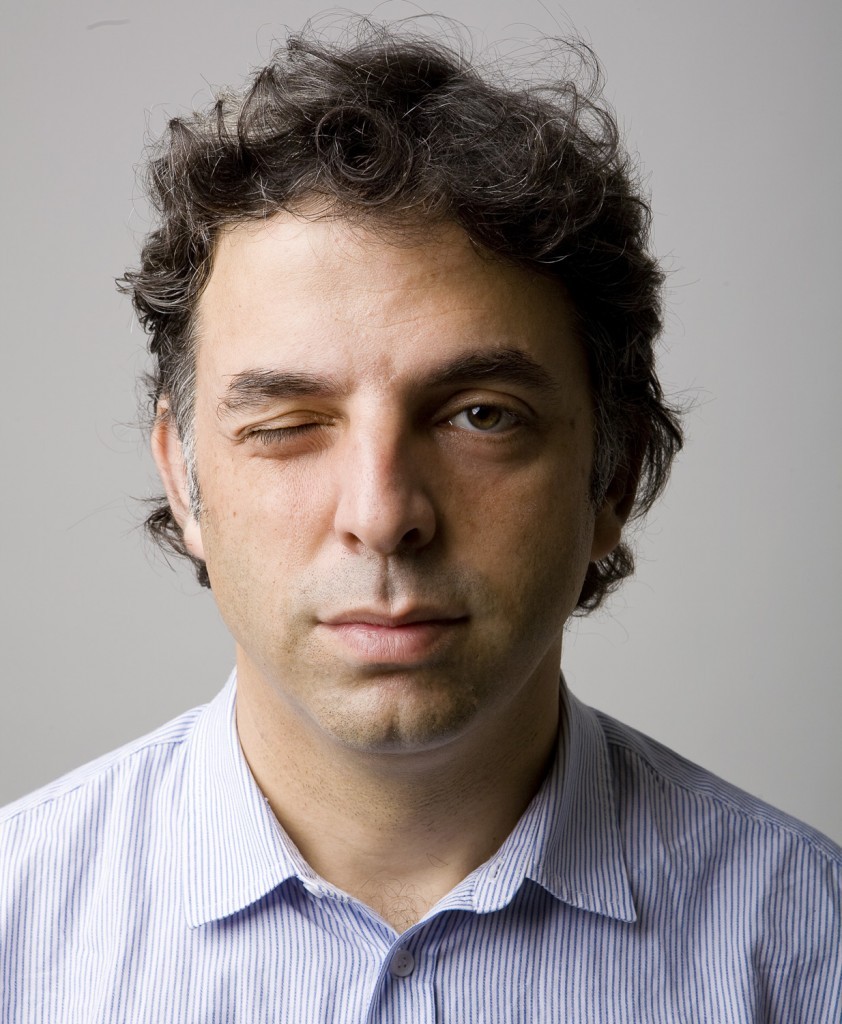
Photo: Etgar Keret, image first featured in Editora Rocco.
 Sarah Byrne
Leave a comment